Anup's Curiosity Chronicles

Essays by Anup Raina

Perspectives Over Time

Anup’s Curiosity Chronicles · a series in five seasons

For four years Anup kept a habit: whenever life taught him something, he wrote it down so he would not forget it. Those notes to self became 446 essays. Each season gathers forty of the best, and every essay opens with a painting made from its own story.

The five seasons

Five seasons, one life seen from five sides

Each season comes as an ebook and as a hardcover art edition, 11 × 8.5 inches, landscape. This is how the author sees the series unfolding today. Like the essays themselves, it may change as life does.
  1. Season 1

    Carry Your Fire

    One flame can light a thousand more

    Ebook first, hardcover to follow

    Look inside →
  2. Season 2

    The Long Game

    Play for decades, not quarters

    Coming next

    Look inside →
  3. Season 3

    Why We Do What We Do

    The ten heads that live in all of us

    Coming next

    Look inside →
  4. Season 4

    Echoes

    The past is still speaking

    Coming next

    Look inside →
  5. Season 5

    Tomorrow’s Questions

    From zero to AI, what do we keep human?

    Coming next

    Look inside →
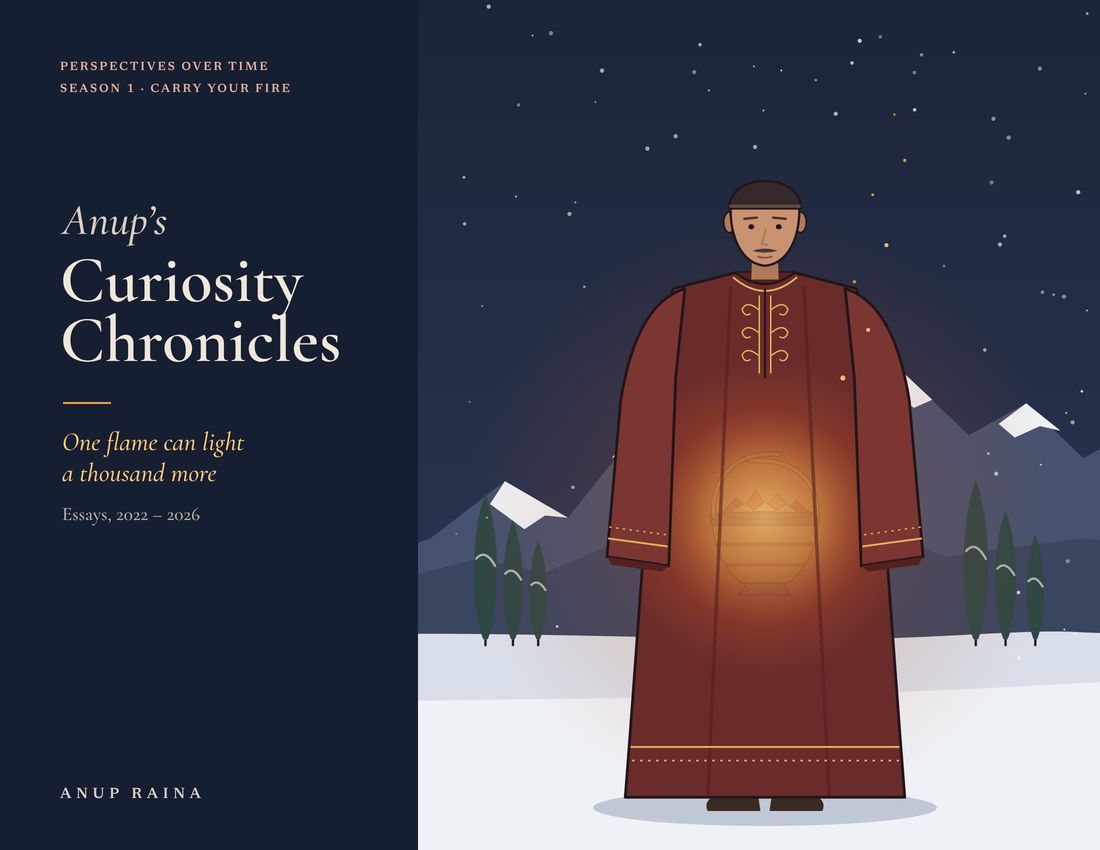
The cover of Season 1, Carry Your Fire: a man in a pheran in a snowy valley, a kangri glowing beneath it

Season 1

Carry Your Fire

One flame can light a thousand more

Roots, crossings, work, faith and loss: a life across borders. Kashmir, Delhi, Munich, and forty paintings, each made from its essay’s own story.

The design

These essays follow a life that starts in Kashmir and keeps its warmth wherever it goes, like the fire in the title. So Kashmir sets the look, a Dal Lake night framed in walnut wood with chinar red and saffron light, and each painting is cubist, one life seen from many sides; the cover is a man in a pheran with a kangri glowing at his heart.

Colours: Dal Lake night, walnut, chinar red, saffron gold

Ebook first, hardcover to follow

Preorder Season 1

Price at preorder · Preorders open soon

Look inside

Pages from the printed book. Swipe for more. Tap a spread to see it large.

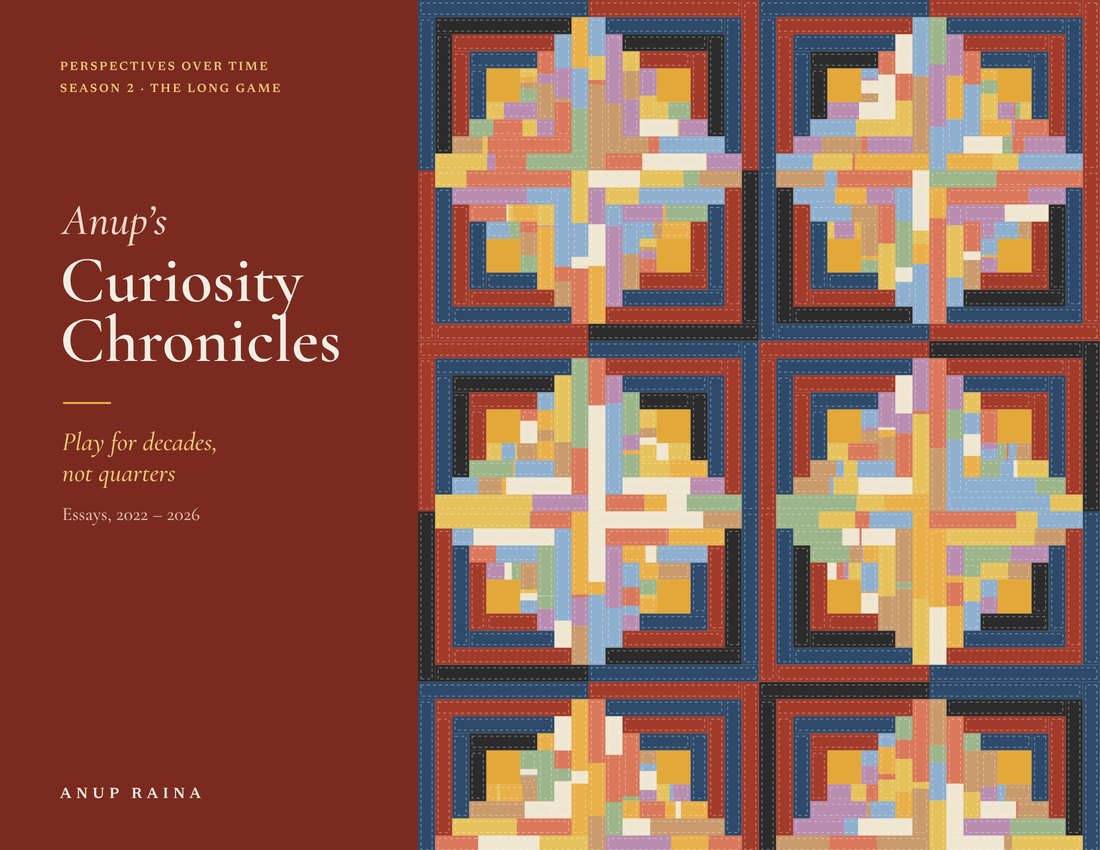
The cover of Season 2, The Long Game: a patchwork log-cabin quilt in barn red, denim and yellow, beside a brick-red title column

Season 2

The Long Game

Play for decades, not quarters

Building, trust and betrayal.

The design

These essays are about building: founders, trust, betrayal and choosing people, told through American stories from Silicon Valley to Pennsylvania, with a feeling of earned optimism. So the art speaks plainly and big, like a screen-print poster, in barn red, denim and highway yellow; the cover is a log-cabin quilt built strip by strip, its light squares pieced from many different scraps, the way things that last are built from many people.

Colours: Barn red, denim, highway yellow, canvas

Coming next

Preorder Season 2

Price at preorder · Preorders open soon

Look inside

Sample paintings · pages coming · swipe for more

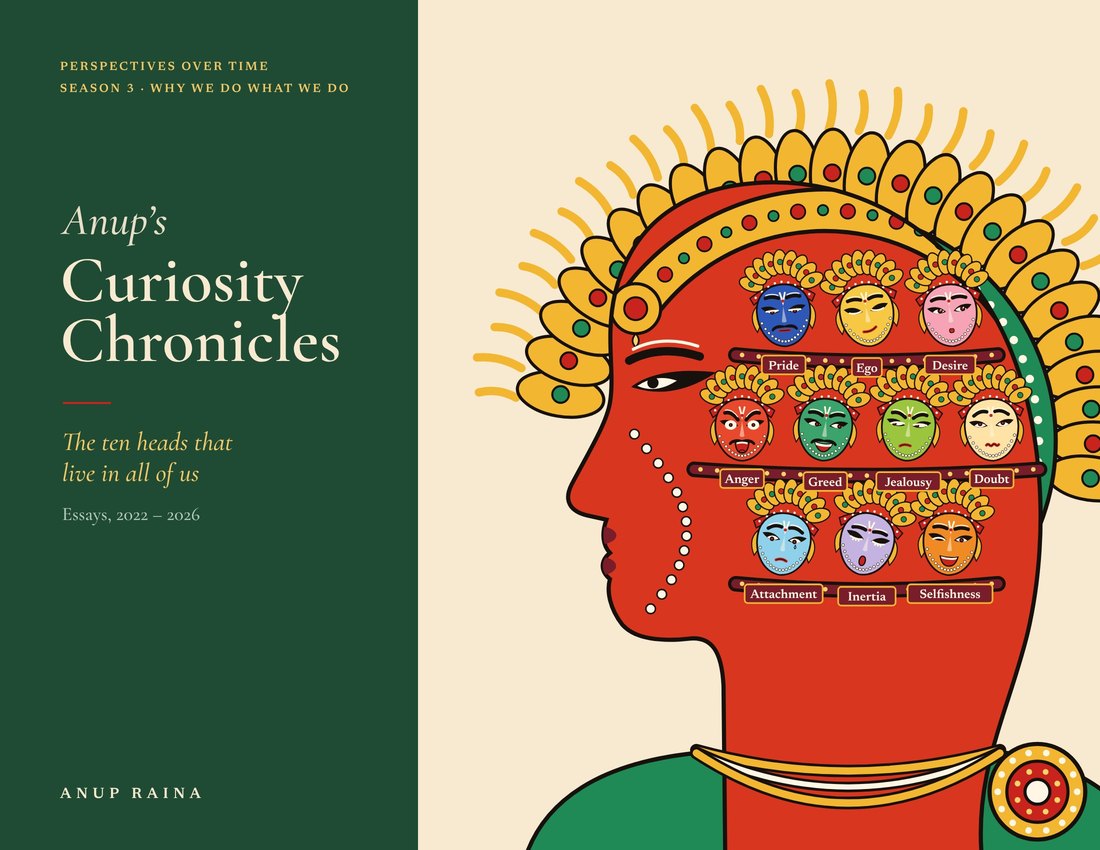
The cover of Season 3, Why We Do What We Do: a Yakshagana profile with ten small faces inside it, each named for a vice: pride, ego, desire, anger, greed, jealousy, doubt, attachment, inertia and selfishness

Season 3

Why We Do What We Do

The ten heads that live in all of us

Why we lie, compare, envy, please, hold on and let go.

The design

These essays look at the ten heads in all of us with honest, gentle self-recognition: wry, never judging, and ending in hope. Ravana’s ten heads are a stage character in Yakshagana folk theatre, and the essays treat the vices as roles we play, so the art borrows its masks, in warm clay, heart red and calm sage; on the cover, ten heads sit inside one calm profile.

Colours: Warm clay, heart red, calm sage, shadow umber

Coming next

Preorder Season 3

Price at preorder · Preorders open soon

Look inside

Sample paintings · pages coming · swipe for more

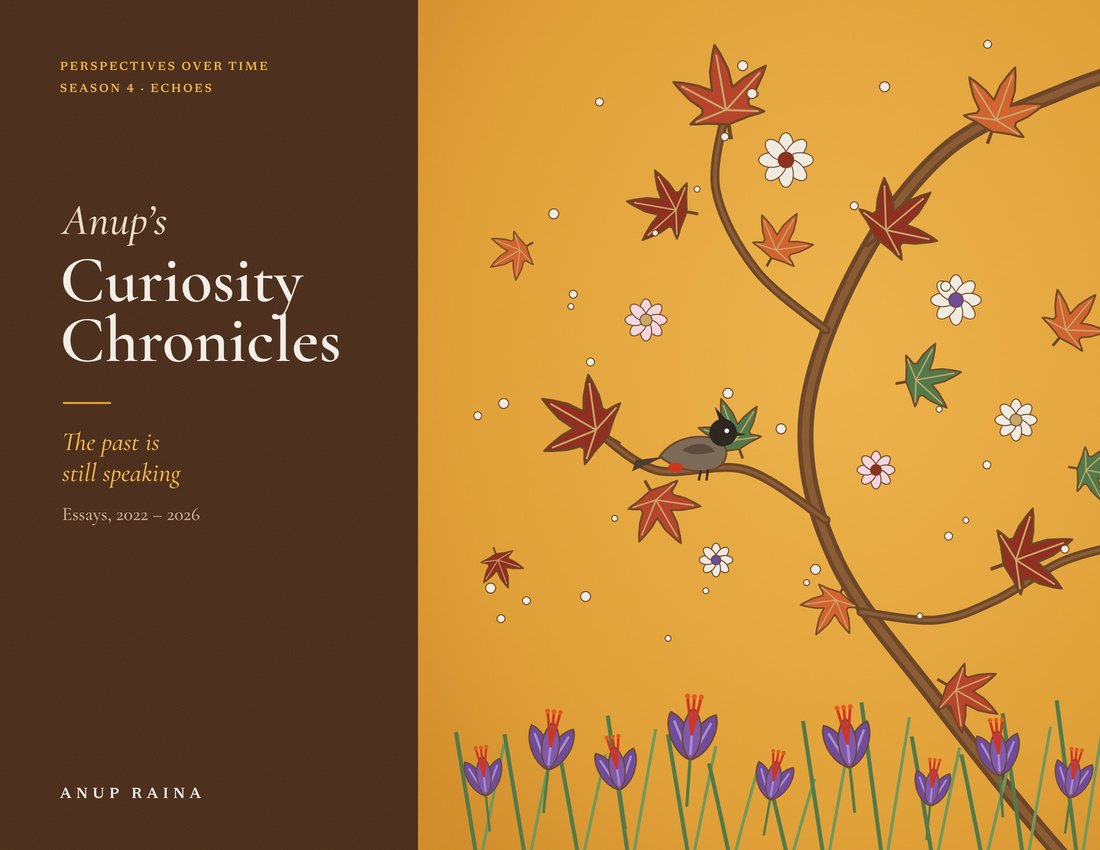
The cover of Season 4, Echoes: a chinar bough with a bird, over a field of crocuses, on saffron, beside a walnut-brown title column

Season 4

Echoes

The past is still speaking

The Valley’s heritage, history and faiths.

The design

These essays return to the Valley’s heritage, history and faiths with reverent nostalgia and wonder: the past still speaks through a cup, a craft or a prayer. So the paintings are miniatures in the Pahari manner, coloured like Kashmiri papier-mâché with saffron in the lead; the cover is a painted chinar bough with a bird over crocuses, on saffron.

Colours: Saffron, chinar red, walnut, Dal Lake night

Coming next

Preorder Season 4

Price at preorder · Preorders open soon

Look inside

Sample paintings · pages coming · swipe for more

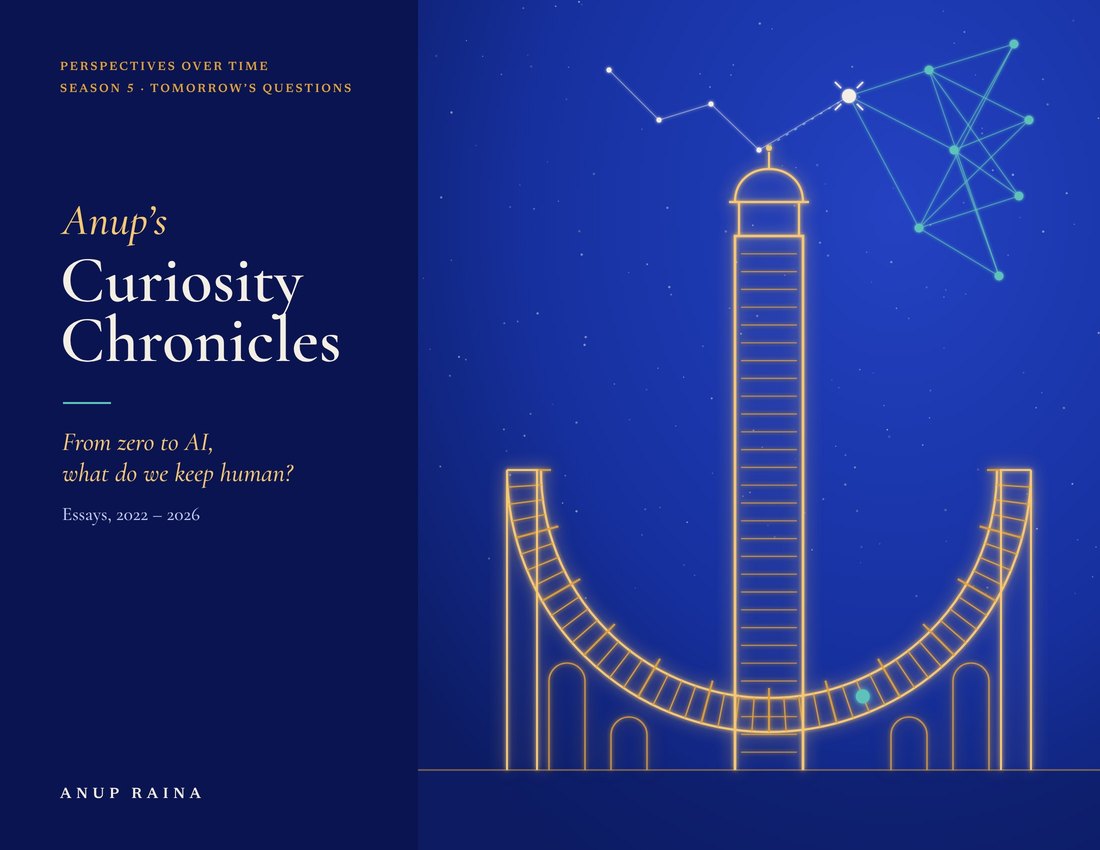
The cover of Season 5, Tomorrow’s Questions: Jantar Mantar drawn in gold lines under the stars, on deep blue, beside a midnight-blue title column

Season 5

Tomorrow’s Questions

From zero to AI, what do we keep human?

From the invention of zero to AI.

The design

These essays are written with wonder and watchful hope: every invention answers one question and opens a bigger one. So the art is a glowing line drawing, like a lamp on the desk at night, in amber and teal on deep blue; the cover is Jantar Mantar drawn in light under the stars.

Colours: Lamp amber, spark teal, deep blue, paper

Coming next

Preorder Season 5

Price at preorder · Preorders open soon

Look inside

Sample paintings · pages coming · swipe for more

The design

How the series is designed

Each season’s look comes from its own essays, in four steps. The essays come first. The colours and the art follow from them. Season 1 is the example.

  1. Selection

    Anup has written 446 essays. Each season takes forty of them, grouped by theme into eight parts of five.

    Season 1: forty essays in eight parts, starting with Roots.

  2. Signals

    The essays are read for their signals: the themes, feelings, places and objects that recur.

    Season 1: Kashmir, Delhi and Munich; the pheran, the kangri and the chinar; roots, crossings, faith and loss.

  3. Theme

    The signals add up to one theme and one place: a title, a line, and a design guide named for its country.

    Season 1: Carry Your Fire, set in Kashmir, India.

  4. Colours and art form

    The colours are taken from those signals. Then one art form is chosen to suit them.

    Season 1: Dal Lake night, chinar red and saffron gold from Kashmir, and cubism, to show one life from many sides.

About the art formsWhat each style is, in a few words
Cubism Season 1
A way of painting that shows one subject from several viewpoints at once, broken into flat, angled planes. Season 1’s paintings use it to show one life seen from many sides.
Screen-print poster Season 2
Each colour is printed as its own layer of ink, so the picture is made of a few bold, flat shapes. It is the look of mid-century travel posters, and of the WPA posters the US government produced from 1936 to 1943, many of them screen-printed. The cover is a log-cabin quilt, a pattern built strip by strip.
Yakshagana Season 3
A traditional theatre form from coastal Karnataka, in south India, that mixes dance, music and dialogue. Its actors wear bold painted faces and large, ornate headdresses. Ravana, the ten-headed king of the Ramayana, is one of its demon roles.
Pahari miniature painting Season 4
Small, finely detailed paintings made in the hill kingdoms of the Himalayan foothills, from the late 1600s to the 1800s. Season 4 pairs them with the colours of Kashmiri papier-mâché, a craft of hand-painted, varnished objects decorated with flowers.
Glowing line drawing Season 5
A modern style, not a historic school: fine lines of light drawn on a deep blue ground, like a blueprint or a star map. The cover is Jantar Mantar, the giant stone instruments for watching the sky that Jai Singh II built in the early 1700s, in Delhi, Jaipur and other cities.

Series bundle

The full series

All five seasons in hardcover, with all five ebooks free.

  • Five hardcovers, each an art edition, 11 × 8.5 inches, landscape, sent as each season is printed
  • Five ebooks, free, for phone, tablet and Kindle, each one as soon as it is ready
Preorder the series

Price at preorder · Preorders open soon

About the author

Anup Raina’s roots are in Kashmir, the land of his ancestors. He grew up in Delhi and now lives in Pennsylvania, about 7,000 miles from the houseboats of Dal Lake. He writes Anup’s Curiosity Chronicles on Substack, where every essay begins with a question life asked him.

Seeing in pictures

Anup has a visual mind. “I do not engage with words or language in my mind; instead, I visualize images or a brief reel of visuals,” he wrote in Essay 300. Those pictures shape how he writes, and they hold feelings that words alone can miss. That is why every essay in these books opens with a painting: it lets the reader see the picture, and feel it, before the words begin.

Read the newest essays on Substack ↗
Anup on LinkedIn ↗

Why curiosity

The series takes its name from Essay 300, written to mark three hundred essays.

“It’s hard to be both curious and hopeless at the same time, because curiosity, by nature, is a hopeful act.”From Essay 300, Curiosity Chronicles